Deege Solar
  • Solar
    • Home Solar
      • Solar Panels
      • Solar Panels & Storage
      • Solar Batteries
    • Commercial Solar Panels
    • Off Grid Solar Systems
    • SAHP
    • Solar Finance
  • Products
    • EV Chargers
    • Tesla Powerwall
    • Sigenergy
    • SolarEdge
    • Enphase
    • Sungrow
    • Growatt
    • GivEnergy
    • Duracell Energy
    • GoodWe
    • Smart Devices
  • Maintenance
    • Solar Maintenance
    • Bird Proofing Solar Panels
    • Solar Panel Cleaning
  • About Us
    • About Us
    • Accreditations
    • Awards
    • Partners
    • Careers
    • Referral Scheme
    • Media & Press
    • Reviews
  • Case Studies
    • Commercial Solar Case Studies
  • Blog
  • Contact
Updated: 6 February 2024

The Best Solar Batteries of 2024

The Best Solar Batteries of 2024
Updated: 6 February 2024

What Is a Solar Battery

A solar battery, similar to any kind of battery, simply stores energy. By storing your solar energy within a solar battery, you end up with a supply of green energy to use whenever your home needs it. Which comes extremely handy during the evening and night, when your solar panel system isn’t able to generate as much power. The benefits of home battery storage speak for themselves, but which solar battery to choose becomes a pressing question.

Who Makes Solar Batteries

With big names such as Tesla, Energizer and Duracell entering the energy game, the list of solar battery suppliers is growing rapidly.

Here at Deege Solar, we install battery storage systems made by Growatt, GivEnergy, myenergi, Sofar Solar and Solax Energy. Just to name a few.

How Do I Know Which Solar Battery is the best?

Depending on which features you wish to prioritise, the best solar battery can differ project to project. Lucky for you, the team here at Deege Solar have put together a list of key features to compare before choosing which solar battery to install.

  • Battery Capacity - kWh

Battery size, also known as Capacity, is the maximum amount of energy in kilowatt-hours, that a battery can store at a given time. Some solar batteries such as the Growatt 3.3kWh are scalable. This means you can add more energy storage gradually, and increase your battery’s capacity over time. Solar batteries come in a range of capacities, the larger the battery capacity the more expensive the batteries tends to be. In the UK, the average household uses around 8-10 kWh of electricity every day. However, the capacity of storage your project will require all depends on your energy consumption. As a solar battery should never be fully discharged, the “useable capacity” indicates the truthful amount of energy a battery can store.

  • Battery Cycle Life

A battery’s cycle life indicates the lifespan of a solar battery. Similar to a phone or laptop battery, a solar battery can only be fully recharged and emptied a certain amount of times. Therefore, the larger amount of lifecycles a solar battery is able to perform the better! As the average lifespan of Solar Panels is 15 years, you would want an energy storage system that can match it. Many solar battery manufacturers offer warranties that guarantee a certain level of performance after a certain number of cycles.

  • Depth of Discharge (DoD)

Depth of Discharge is the maximum percentage of a battery’s capacity that is useable without the need for a recharge. Although a battery will state a capacity, you will never be able to use that full amount. This is because draining a battery completely can damage the battery itself. The Depth of Discharge is there to help you understand how much of the battery’s total capacity can actually be safely used. For example, Growatt’s 6.5kWh battery has a depth of discharge of 94.5%. This means that although its total capacity is 6.5kWh, only 6.14kWh can be use before recharging, otherwise the battery can get damaged. Hence why on the Growatt’s 6.5kWh datasheet the usable capacity is 6kWh.

To conclude, the higher the Depth of Discharge, the more of your battery storage you can actually consume on a day to day basis. 

  • Charge/Discharge Rate

A batteries’ charge rate is the rate of time it takes to charge or discharge in Amps. The charge/discharge rate is calculated by dividing the capacity of the battery by the number of hours it takes to charge/discharge.

Most common UK and EU households will use low voltage batteries with a discharge/charge rate of 3kW. High Voltage solar batteries, which are not common residentially, have a 5kW charge/discharge. A higher charge/discharge rate means that your solar battery is capable of handling higher base loads and surges. We are seeing these types of batteries becoming more popular in the home, as the energy demand within the home is constantly rising. 

  • Smart Grid Trading

Some solar batteries such as Moixa, GivEnergy and Solax, allow for autonomous grid trading. Smart, automatic grid trading, takes the control out of the user’s hand and puts it into the hand of artificial intelligence. Trained to save you money. Batteries that allow for autonomous grid trading take advantage of tariffs such as Octopus Agile or Social Energy. The integrated AI automatically charges your battery from the grid when the cost per unit of energy is low. This not only improves the balance of renewable energy on the National grid network but also reduces your green energy waste. Allowing other connected users to power their home on your clean energy.

  • Cell Technology

Similar to the battery technology found in your electric vehicles, tablets and phones, many solar batteries are Lithium-ion based. Known for their low life-time cost, and higher efficiency, lithium-ion batteries are seen as the batteries of the future. The most modern Lithium ion technology used in solar batteries is Lithium ion phosphate (LiFePO4 or LFP). Compared to lead-acid batteries and other lithium batteries, LiFePO4 batteries have a longer life span. They also have an improved discharge and charge efficiency, are lightweight and extremely safe.

Lead acid batteries still remain popular amongst homes looking to go off-grid, with a cheaper upfront cost.

  • Monitoring

Monitoring platforms such as Shine Smart Monitoring, make it possible for users to view and monitor their energy usage. By gaining access to this data, each customer is able to view how much energy is being stored in their battery. The user will also be able to see whether or not their battery is charging, and how much energy their solar PV system is generating. These monitoring platforms are usually accessible via an app on your phone or web browser.

To some users the ability to see how they are using their energy is invaluable, for less tech-savvy users this feature isn’t as important.

  • Ac vs DC Battery Systems

There are two types of battery installation systems, known as DC and AC coupling. AC or DC coupling refers to the way solar panels link to a solar battery or energy storage system. The key distinction between an AC-coupled and DC-coupled battery system lies in the journey the electricity takes. A DC battery system is more efficient in converting solar energy, as it connects your PV system directly to the solar panels. Whereas, an AC-coupled system connects your solar panels directly to an inverter. As a result, any electricity stored in a battery system is effectively inverted three times.

Read more about AC and DC coupled batteries.

  • Powercut supply

Despite popular belief, not all solar batteries are capable of supplying energy during a power-cut. As your solar panels and battery connect directly to the main grid, your solar inverter will automatically switch off your system during a power cut. This is so that it is safe for the engineers to work on the grid. However, if your solar battery has back-up storage functionality you can still gain power.

Solar batteries which have back-up functionality have an auto transfer relay switch. As your solar panel system detects a drop in voltage on the grid, your home will automatically disconnect from the grid. Connecting to your solar back-up supply instead. This is referred to as islanding. Islanding relies on a hybrid solar solution to provide an Emergency Power Supply (EPS). An EPS is designed to power your essential circuits during a power cut, and is usually priced as an upgrade. A hybrid solution with EPS, will still allow the batteries to charge from your solar when there is no grid supply.

  • Warranty

Just like any household appliance, solar batteries also come with a warranty. The warranty of a solar battery is often an indicator of how long you can expect your home battery to last. Defined by the number of cycles the battery is able to complete. Usually, more expensive batteries include longer warranties, as the battery is more durable. 

Solar Battery Comparison

Below our green team have put together a comparison table for some of the battery storage systems available on the market. If you would like to find out more information regarding solar batteries contact our team on 01322 479369.

Solar BatteryStorage
Capacity
(kWh)
Depth of DischargeUseable
Capacity
(kWh)
Discharge RatePriceWarrantyPower Cut
(EPS)
AC or DC
Coupled
MonitoringSmart ChargingIndoor or
Outdoor
Flexible StorageTechnolgy
Pylontech Solar Battery Storage2.4kWh90% 2.2kWh-£10 YearsYesBothSolarman MonitoringYesIndoors & OutdoorsUp to 16 batteries (38.4kWh of Storage)LiFePO4
Growatt Ark LV Solar Battery Storage2.56kWh90% 2.3kWh4kW££10 YearsYesBothShine Smart MonitoringYesIIP65 - Suitable for Indoor and Outdoor Installation.Up to 10 Batteries (25.6kWh of Storage)
Cobalt Free
LiFePO4
Growatt Solar Battery Storage3.3kWh93% 3.1kWh3kW£10 YearsYesBothShine Smart MonitoringYesIP20 - Indoor OnlyUp to 6 Batteries
(19.8kWh of Storage)
LiFePO4
Duracell Battery Storage for Solar3.3kWh90% 3kWh-£££10 YearsYesBothYesSocial Energy CompatibleIP32 - Indoor OnlyUp to 2 BatteriesLiFePO4
Puredrive battery5 kWh---££10 YearsYesBothPuredrive MonitoringYesIP67 -Indoor &
outdoor
Up to 5 Batteries (25kWh of Storage)LiFePO4
myenergi libbi battery5kWh92%4.6kWh5kW£££10 YearsYesBothmyenergi MonitoringYesIP65 - Suitable for Indoor and Outdoor Installation.Up to 4 Batteries
(20kWh of Storage)
LiFePO4
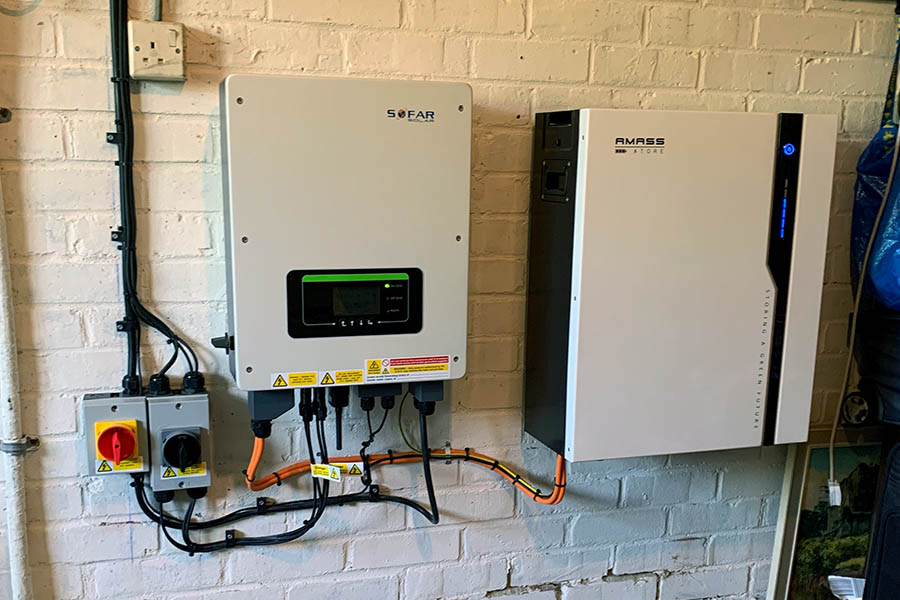
Sofar Amass Solar Battery Storage5.12kWh80% 3.5 kWh£10 yearsYesDC OnlySolarman MonitoringYesIP20 - Indoor OnlyUp to 4 Batteries
(18.4kWh of Storage)
LiFeP4
Sunsynk battery 5.12kWh5.12kWh90%4.6kWh5.12kW£10 YearsYesDC OnlySunsynk ConnectWorks With OctopusIP65 - Suitable for Indoor and Outdoor Installation.Up to 16 Batteries
(81.92kWh of Storage)
LiFePO4
Goodwe Inverter and Battery5.4kWh90%4.8kWh5kW£10 YearsYesBothGoodWe MonitoringYesIP65 - Suitable for Indoor and Outdoor Installation.Up to 6 Batteries (32.4kWh of Storage)LiFePO4
Solax Solar Battery Storage5.8kWh90% 5.22kWh5kW££10 YearsYesBothYesSocial Energy CompatibleIP55 - Indoors & OutdoorsUp to 4 Batteries (23kWh of Storage)LiFePO4
Growatt Solar Battery Storage6.5kWh92% 6kWh4kW£10 YearsYesBothShine Smart MonitoringYesIP55 - Indoors & OutdoorsUp to 8 Batteries
(52kWh of Storage)
LiFePO4
GivEnergy 9.5kWh Batter9.5kWh100%9.5kWh3.6kW£££10 YearsYesBothGivenergy MonitoringWorks With OctopusIP65 - Suitable for Indoor and Outdoor Installation.Up to 5 Batteries (47.5kWh of Storage)LiFePO4
SolarEdge Energy Bank10kWh97%9.7kWh5kW£££10 YearsYesDC OnlySolaredge MonitoringYesIP55 - indoor and outdoorUp to 3 Batteries (30kWh of Storage)Lithium-ion
Givenergy all in one 13.5kWh battery13.5kWh100% 13.5kWh 6.2kW£££12 YearsYesBothGivenergy MonitoringWorks With OctopusIP65 - Suitable for Indoor and Outdoor Installation.Up to 6 Systems (80kWh of Storage)Unknown
Tesla Powerwall 2 Battery13.5 kWh100% 13.5kWh5kW£££10 YearsYesDC OnlyTesla MonitoringYesIP67 - Suitable for Indoor and Outdoor Installation.Up to 10 Batteries
(135kWh of Storage)
Lithium-ion

How Do I Get A Solar Battery Installed?

If you are a UK homeowner looking to install the best solar battery, get in touch with our green team. As MCS certified Solar Panel Installers, with over 12 years of experience, when you choose Deege Solar you know you are in safe hands. There is no time like the present to invest in battery storage here in the UK, as solar battery installations are currently VAT-free! Call us today on 01322 479369 or click the enquire now button to talk to a solar expert!
Enquire Now
Solar Batteries
Youtube Facebook-f Instagram Linkedin
  • enquiries@deegesolar.co.uk
  • 01322 479369
Previous articleNet-Zero: What Does It Mean and How Can We Achieve It?Net ZeroNext article AC or DC Coupled Solar Batteries?AC Coupled Solar Battery System

About The Blog

Hi, we are Deege Solar and this is our blog, where we will be covering everything regarding Solar energy: from Solar Panels, Solar PV Systems, Battery Storage, EV Charges, and Solar Maintenance.

If you are a UK home of business owner interested in going solar, call 01322 479369 for a FREE quote! 

Recent Posts

  • Can You Install Solar Panels On A Garage Roof?
  • Are Fogstar Batteries any Good?
  • Frequently Asked Questions About Solar Inverters

Subscribe To Our Channel

Deege Solar Logo

Services

Solar PV & Storage
Solar Panels
Solar Batteries
Commercial Solar
Off Grid Solar Systems
EV Chargers

Contact

01322 479369
enquiries@deegesolar.co.uk
Mon – Fri 9:00am – 5pm

Deege Solar is the trading name of Deege Ltd

Company Info

Unit 4, St Margaret’s Estate,
St Margaret’s Road, South Darenth, Dartford, Kent,
DA4 9LB

Registered Business in England & Wales

Other

VAT Number: 275 9754 45
Company Number: 10633363

Privacy Policy
Cookie Policy
Complaint Policy

Copyright

Copyright Ⓒ 2020 | Website Designed & Created by Pico Designs for Deege Solar

Deege Solar is a trading style of Deege Ltd. Registered at Unit 4, St Margaret's Estate, St Margaret's Road, South Darenth, Dartford, Kent, DA4 9LB. Reg No. 10633363. We are authorised and regulated by the Financial Conduct Authority FRN935961. FCA Registration No. 935961. We are a credit broker not a lender and offer finance from a panel of lenders. Credit is subject to status and affordability.