Can solar panels be mounted on the ground?
Although when many think of solar energy, they picture solar panels mounted on top of roofs, there are in fact many different ways solar panels can be installed. And If you roof isn’t suitable for solar panels yet you have large land available, then a ground mounted solar panel system might be the solution to your energy needs.
Whilst on-roof solar panels make use of rooftops, ground mounted solar panels make use of land. According to the Natural Environment Research Council (NERC), 47% of Solar Panels in the UK are ground mounted as part of larger solar farms or solar parks. Although often used for solar farms, this doesn’t mean that ground mounted solar panels can’t also be installed domestically.
Ground mounted solar panels are an effective way of generating solar power. Although most residential homes don’t necessarily have spare land, ground mounted solar is a great choice for commercial properties or utility solar farms.
How are solar panels installed on the ground?
Solar panels can be installed on the ground using various methods and types of solar panel mounting.
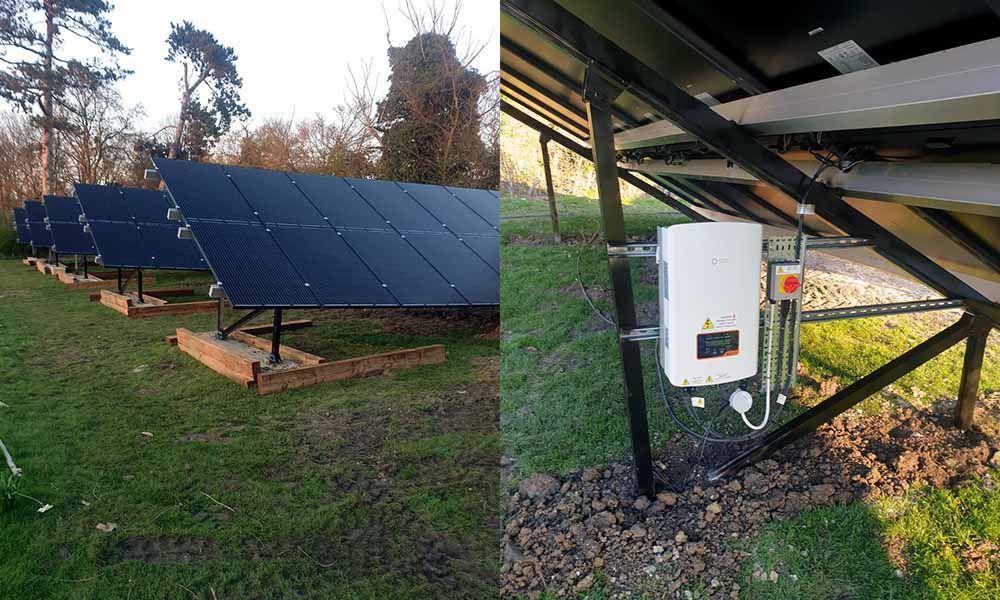
When installing a ground mounted solar panel system, the solar panels are attached to a frame using clamps or mounting brackets, which holds them at the best angle for optimal sun exposure. This angle also help to keep them resistant to rain, and snow. You can arrange the panels in a variety of layouts, including portrait or landscape, at single height or stacked. Nevertheless, whilst designing the solar installation, the panel layout must ensure that the row spacing is adequate enough to minimise shading.
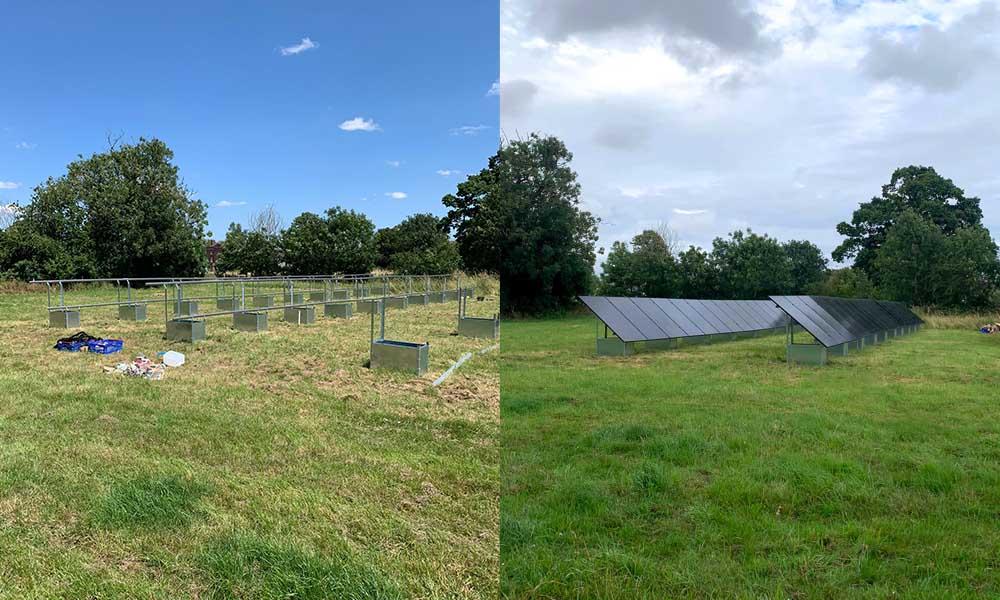
The ground will need to be prepared before installing the solar panels. The area will need to be levelled in order to support the structure, and cleared of any obstructions. Grading or excavation may be required to ensure a flat and stable surface.
Types of Ground Mounted Solar Panels
- A Standard ground mount in which a metal A-frame is fixed into a concrete base or a pole that’s pile driven into the ground.
- A solar tracking system, which moves the solar panel over the course of the day to follow the sunlight.
-
A ballasted plastic tube which sits directly on the land. This type of system is also used on solar panels for flat roofs.
- A wooden frame, which is often a bespoke system and can double up as another structure.
ground mounted solar panels pros and cons
The pros Of Ground Mounted Solar Panels
- Installing ground mounted solar panels is a great solution for property owners with a fragile, shaded or small roof, which isn't suitable for solar panels.
- Whereas on-roof systems impact your warranty, grounded mounted solar saves you the trouble of having to drill into your roof.
- The biggest advantage with ground-mounted solar panels is that they offer greater control over your solar panel direction and angle. By setting your panels at the perfect pitch and orientation your panels can get optimal sunlight exposure making it possible to generate more electricity.
- As this type of installation is at ground level, the system is safer and easier to access, maintain and clean. This means you won't have to pay a specialist to clean your system, and can easily sweep off the snow in the winter months to ensure you are still generating.
- As you are not restricted to the size of your roof, ground mounted systems tend to be larger and are easier to expand.
- Plus you will receive all the same benefits as an on-roof system including a reduced energy bill, a smaller carbon footprint and payment for your exported energy through the Smart Export Guarantee.
- Another advantage of ground mounted solar panels, is the design flexibility they offer. Ground mounting solar panels can be installed portrait, landscape, stacked or individual in height. With some frames, you can even adjust the pitch of the panels to take advantage of the seasonal change in the angle of sunlight.
The Cons Of Ground Mounted Solar Panels
- When you choose to install on-roof solar panels you are using space which otherwise wouldn't be occupied, however ground mounted solar panels take up land which could be used for other things.
- Components are easier to steal, if the land is easily accessible.
- Requires large amounts of free space, which isn't shaded or occupied.
- Your choice of panel may be limited due to sizing restrictions of the frames available.
- In terms of infrastructure, a ground mounted solar array require trenches for cabling, inverters and spacing between rows of panels to allow for shading. This added labour may mean your solar installation is likely to cost more.
If you are looking for more information regarding the pros and cons of ground mounted solar panels, make sure to head over to our Youtube Channel @deegesolar for a full video run down.
Things to Consider before installing Ground Mounted Solar
The ecological impact
A main concern surrounding the installation of ground mounted solar is the impact on the local wildlife and ecosystem. However, if your solar project is designed correctly the local wildlife could also benefit.
Usually because ground mounted solar panels are installed at a fix height above the ground, they can offer shade and protection for wildlife in adverse weather conditions. Providing a shelter from rain, snow and sun. What’s more, installing a ground mounted system isn’t destructive, so if at any point you wish to decommission the system, the land can still be used.
According to the Building Research Establishment, infrastructure for solar farms impacts less than 5% of its ground space. However, if the ecological impact of ground mounted solar panels or solar farms is something that concerns you, luckily researchers looking at the wildlife impacts of solar farms from the University of York and Lancaster, have developed the SPIES tool, to promote the enhancement of biodiversity and ecosystems in solar farms. The tool can be downloaded from the project website at: http://www.lancaster.ac.uk/spies/.
Do you need planning permission for Ground Mounted Solar Panels?
According to the UK Planning Portal, ground mounted solar panels fall under permitted development as long as the following criteria is met:
- No part of the installation should be higher than 4m
- The installation should be at least 5m from the boundary of the property
- The size of the array should be no more than 9 square metres or 3m wide by 3m deep
- If the property is a listed building or a scheduled monument, then solar panels should not be installed within the boundary.
- If your property is in a conservation area, or in a World Heritage Site, no part of the solar installation should be nearer to any highway bounding the house, than the part of the house that is nearest to that highway.
Getting Ground Mounted Solar Panels Installed in the UK
If you are a UK home or business owner considering to install ground mounted solar panels, get in touch! The green team here at Deege Solar will be more than happy to help you on your Solar journey. As award winning solar panel installers in the Essex, England we have over 12 years of experience designing and installing both domestic and commercial solar systems. Call us on 01322 479369 or simply click enquire now to fill out our short form, to get connected to a Solar Energy expert.