If you are considering going solar, it’s likely that you have questioned whether or not your roof is suitable for solar panels in the first place. That’s why at Deege Solar we have put together a brief checklist guideline to direct you as you start your solar journey.
You’ll be happy to know that the majority of UK homes have a roof suitable for solar panels. When considering if your home is eligible for solar panels there are a number of questions you should ask yourself:
1. Does my roof get a lot of sunlight throughout the course of the day?
2. What type of roof do I have?
3. Is my roof large enough to fit solar panels on?
4. Is my roof in good condition?
3. Is there a lot of shading on my roof?
If you would like professional advice as to whether or not your home is suitable for solar panels, then simply click enquire now and our award-winning solar installation team will be able to offer you a free remote survey, design and savings forecast.
-
The Orientation of Your Roof
The orientation of your roof will give you the roof’s position in relation to the sun. As we all know the sun rises in the east and sets in the west. In order for solar panels to produce their maximum output, they need access to as much sunlight as possible.
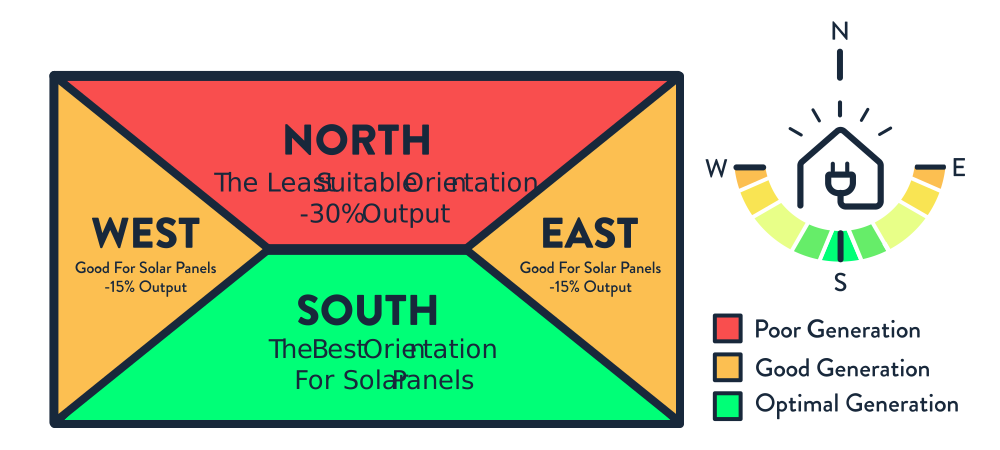
The diagram above indicates how different roof orientations can impact how suitable your roof is for solar panels. The best type of roof for solar panels is a south-facing roof as they tend to generate the most electricity from solar panels, as they are exposed to the sun’s energy when it’s most intense (midday) and for the longest period. You can also have a good-performing solar panel system if you have an east and west-facing roof, as you will have exposure in both the morning, afternoons and evenings. Your roof may be unsuitable for solar panels if it faces north, as this will have a direct impact on your generation.
How can I calculate the orientation of my roof?
The simplest and most accurate way to calculate which direction your house faces is by using a compass. Luckily in this day and ages the majority of smartphones come equipped with a free-to-use compass app.
You can also find the orientation of your roof by using Google Maps. By simply entering your postcode and locating your home. As the map is orientated to the north, if your roof face towards the bottom of the screen, this means that you have a south-facing roof.
-
The Pitch of Your Roof
The pitch of your roof, is the angle at which your roof slopes/inclines. This angle is created by your roof rafters, and has a direct impact on the amount of energy your solar panels can collect from the sun. The higher the rise of your roof, the steeper your pitch will be. In the UK, due to the often wet, windy weather conditions, most roof pitches sit between 30 – 50 degrees.
Your roof pitch can be categorised into 4 types: Flat Roof, Low Pitched Roof, Conventional Roof and High-pitched Roof.
- Flat roofs, in order to allow water to runoff, are not perfectly flat. In reality, any roof less than 12.5 degrees is considered a flat roof.
- Low Pitched roofs are defined as less than 25 degrees.
- A Conventional roof, is the easiest to construct, and maintain. They often have a roof pitch between 25 to 47.5 degrees.
- High-pitched roofs, are roofs with an inclination over 47.5 degrees.
How to Calculate your roof pitch?
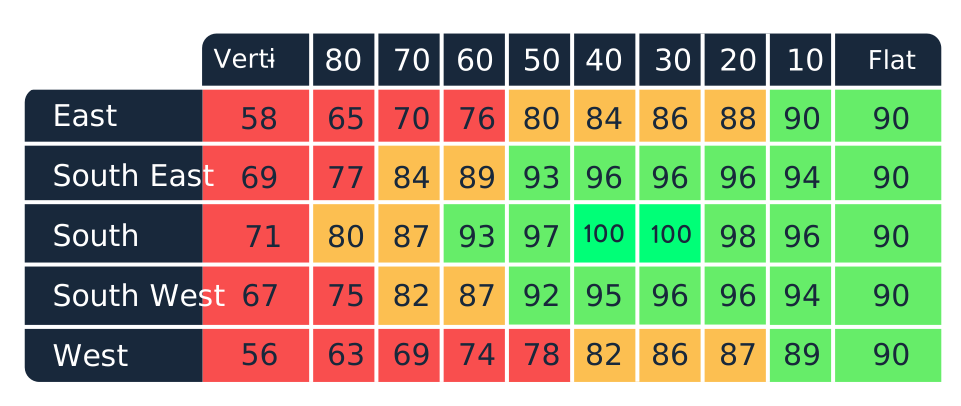
The table above shows how the orientation of a roof, combined with the roof pitch can impact a solar PV system’s overall generation. As you can see the best roof for solar panels is south facing, with an inclination between 40 to 30 degrees. This type of installation will give your solar panels the most exposure to the sun, over the longest period, resulting in a greater return on your investment.
-
Your Roof Space
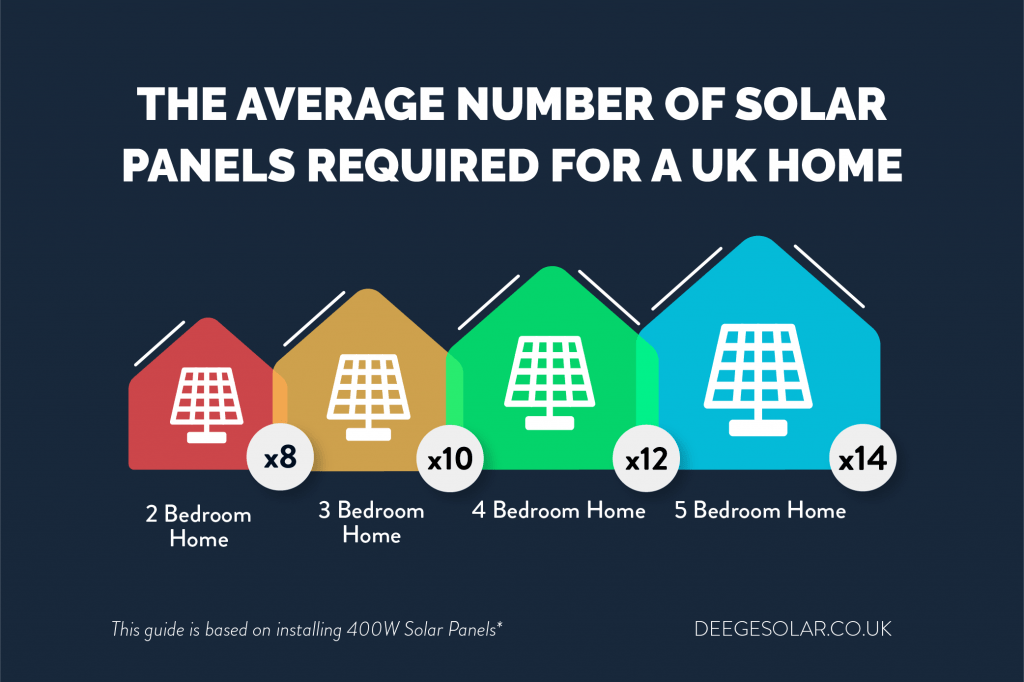
It’s a no-brainer that the larger your roof the more panels you can install, and the more power you can generate. However, when it comes down to roof space, the main question is, is your roof large enough to install enough solar panels to cover your energy bill?
Currently, 400W Solar Panels are the UK industry standard for installations. The average home will need to have the capacity to install at least 10 x 400W Solar Panels in order to fit the recommended 4kW Solar PV System. However, if you are looking to charge an electric car with your solar panels, use your system to heat your water, or run electric radiators, you will be looking for a much larger system.
If you want to be as grid-independent as possible, it is important to know how many panels your roof can fit. Any obstacles, such as skylights, roof vents, and chimneys are likely to interfere with your possible solar panel layout. In the early stages of considering going solar, you may want to consider what kind of panel layout you would like, and use those with solar panels installed locally to you as an indication of how many solar panels your roof can hold.
-
Your Roof Condition
In order to have solar panels installed on your property, your roof needs to be strong and secure enough to hold the weight of the panels. Prior to an installation, all certified installers should evaluate the condition of your roof to see if the roof is structurally sound. Signs of a damaged roof can include: falling mortar, a rotting underlay, loose or missing tiles, mould and moss growth, water damage and rotting roof trusses, battens or purlins. A roof in poor condition will need treatment prior to considering solar panels.
On the contrary, you may want to consider the impact of installing solar panels onto a brand-new roof also. Installing solar panels on a brand-new roof may impact your warranty, therefore you may want to speak to your contractors prior to an installation.
-
Roof Type
Roof material can have a significant impact on the cost of your solar installation, and the home’s suitability for solar. For example, installing solar panels on slate roofs is a lot more labour-intensive, and requires additional materials which have to be considered.
Although solar panels can be installed on the majority of UK roofs, there are 3 types of roofs which are a no-go. These are Thatch roofs, Asbestos Roofs, and Glass Roofs.
1. Thatch roofs: As there is an increased risk of fire.
2. Roofs containing Asbestos: As this is a safety hazard for installation teams to work with.
3. Glass roofs: As they are too fragile to support the solar panels and fixings.
Nevertheless, if your roof isn’t suitable for solar panels there are other options too. For example, you may be able to install ground-mounted solar panels to take advantage of any shade-free land you own.
-
roof shading
When considering if your home is suitable for solar panels, shading can be a be-all and end-all factor. As shading will limit the amount of sunlight your roof gets exposed to, and therefore reduce your system’s output.
Shading can be caused by numerous external factors. Such as nearby trees, buildings, chimneys, satellites, and waste vents. It is important to identify if the shading is Dynamic (Temporary) or Static, (Permanent), and how much of an impact it will have on your system’s performance.
Although the shading may only appear on one panel, because solar panels are wired together on a string, the entire system’s performance is affected. There is of course technology to help reduce the impact of shading on a solar panel system, these are known as DC Power Optimisers. Installing either Solaredge or Tigo panel optimisers come with several benefits, however, will add to the cost of your total installation.
A well-designed solar panel system can minimise the impact of shading. That is why it is important to talk with an expert and to identify possible shading factors at the point of the design. In fact, EPVS will refuse to validate an array with 30% or more shading.
Is Your Home Suitable for Solar Panels
Even if your roof doesn’t fit the ideal requirements, it can still be suitable for solar panels. By speaking with a professional, they will be able to advise on different designs and technologies to maximise your system’s performance. From wall mounted to ground mounted solar panels, our team offer a variety of different ways to install solar panels to ensure the going solar is a viable option for every household, business and community.
If you are a UK home or business owner wanting to see if your roof is suitable for solar panels, then don’t hesitate to call one of our energy advisors on 01322 479369 today. Our trained team of specialists offer free remote surveys and designs, in order to calculate your home’s suitability for solar.