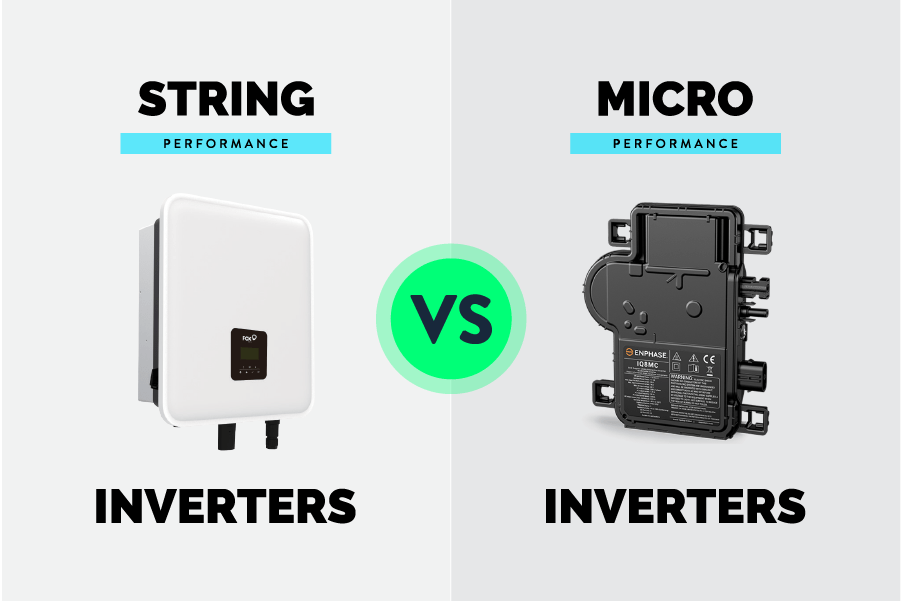
Solar panels create direct current (DC) electricity that must be transformed into alternating current (AC) electricity for use inside your home or business. Solar inverters help complete this process by converting DC electricity into AC electricity. There are many different brands and types of solar inverters available on the market. Both string inverters and microinverters serve this essential function, but they do so in fundamentally different ways, each with its own set of advantages and considerations.
As the brains of a Solar PV system, inverters play a pivotal role in maximising the potential of solar energy. In this blog post, we will explore the differences between string inverters and microinverters, their respective key features, benefits and limitations. Join us as we explore which inverter technology—be it string inverters or microinverters—might be the most suitable choice for your home or business.
What are String Inverters?
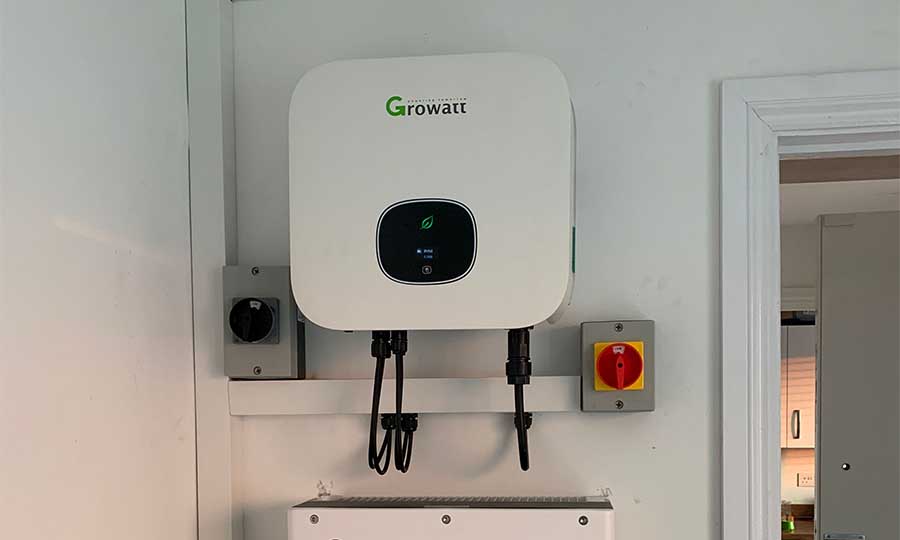
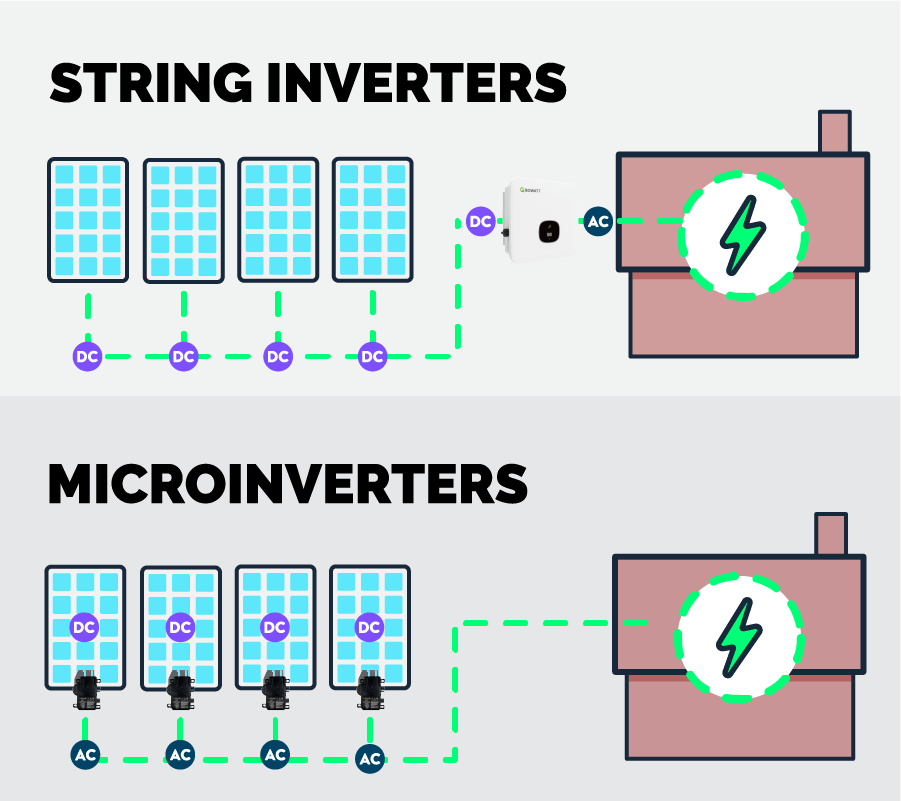
In a solar PV system, a string is a term used to describe a series of solar panels wired together which form an array. These panels as a collective generate DC electricity and this combined DC power is sent to what is known as a string inverter. A string inverter is a standalone single unit, which is typically installed inside your property, around your generation meter.
It monitors and optimises the performance of the entire string, ensuring that the output is efficient, through the use of Maximum Power Point Tracking (MPPT). Since each panel performs at a different level, due to a variety of factors, MPPT is an algorithm that finds the point at which the solar panel generates the maximum amount of power.
The size of the string inverter your system requires with be dependent on the Power of each panel, and the quantity of solar panels you are looking to have installed. Typically, single-phase string inverters go from 2kW to 6kW in size and have 2 MPPT ports. However, multiple string inverters can be installed to communicate in parallel if needed for larger domestic solar panel installations.
The Advantages of Installing A String Inverter
- Affordability. As string inverters can handle the conversion for multiple solar panels, resulting in less hardware for your system, string inverters are typically the most cost-effective solution. Compared to other types of inverters, string inverters require fewer labour hours for installation, making it no surprise that they are one of the most inverters affordable on the market.
- Fewer Connections. One of the primary benefits of string inverters is that you usually only need one to convert DC electricity to AC electricity efficiently. String inverters are easy to troubleshoot, making it easier to get your solar system running again. As string inverters have fewer connections both repairs, fault finding, and installation times are reduced. There is also less of a chance of the system being wired incorrectly, making them easier to troubleshoot.
- Greater Variety. Given their conventional nature, there is a wide array of well-established and reputable brands which manufacture string inverters in contrast to microinverters. Leading brands including Growatt, Solis, and Fox Ess, among others, contribute to this extensive selection, offering homeowners a wide array of choices across various budget ranges.
-
Monitoring. String inverters often come equipped with monitoring systems that allow users to track the performance of each string of solar panels. This is a great way for users to track their energy generation and consumption and helps in identifying and addressing issues.
The Disadvantages of Installing a String inverter
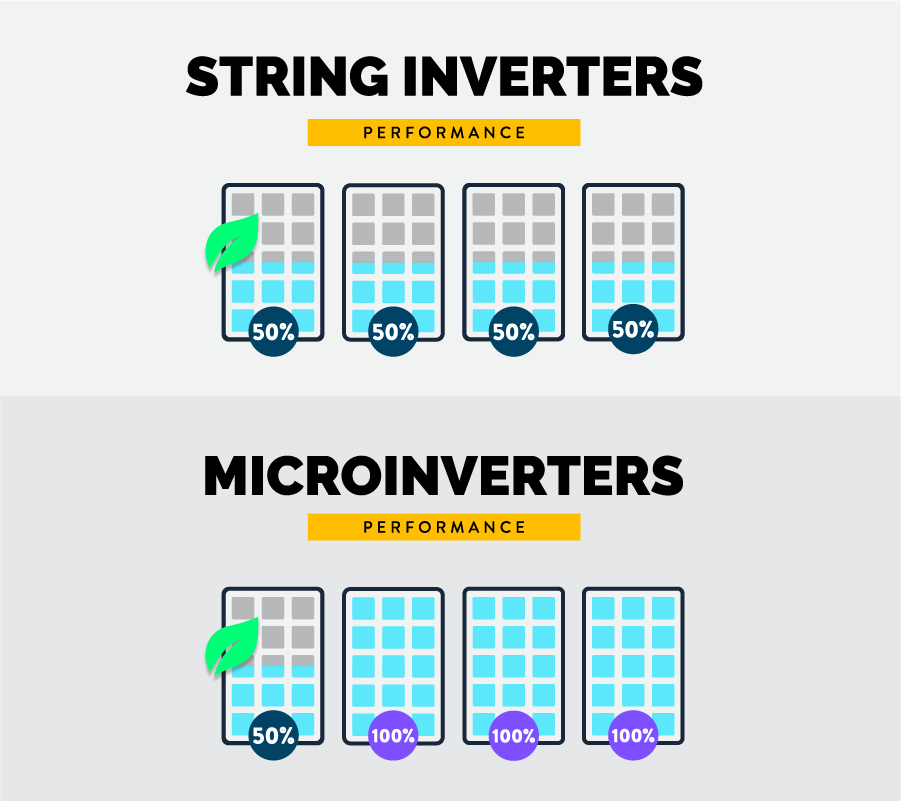
- Reduced Efficiency. The main disadvantage of installing a string inverter is that the performance of the entire string can be impacted by just one panel in the string being shaded, dirty or faulty.
- Limited system expansion: String inverters perform at their best when operating near their peak capacity. If you looking are looking to expand your solar system at any point, you will more that likely need to install another string inverter which adds additional costs.
- Shorter life spans: Unlike microinverters, string inverters have shorter life spans, usually around eight to 12 years.
-
Challenges with System Monitoring:
While you do have access to the total energy production of your solar panels, String inverters are unable to show you module-level data. This makes it more difficult to determine if there are any individual panel performance problems.
What are Microinverters?
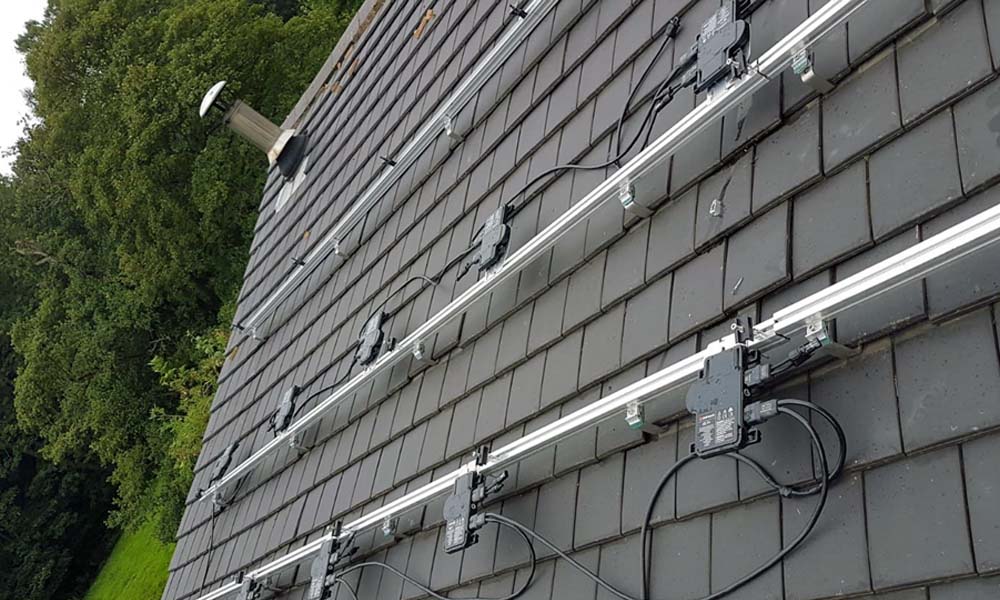
Microinverters, as the name suggests, are a much smaller version of a traditional inverter. Unlike a string inverter, which is designed to manage the DC-to-AC conversion for a string of solar panels, microinverters convert Direct Current to Alternating Current, from directly behind each solar panel. In a solar panel system utilising microinverters, each solar panel is equipped with its own microinverter, roughly the size of a typical internet router, which effectively means that each module gets in own MPPT. The number of microinverters you have to install is dependent on the number of solar panels within your system. The microinverters are connected in parallel before sending the collective AC current to your home and the grid.
Founded in 2006, Enphase Energy is known for pioneering and successfully commercialising the use of microinverters in solar PV systems and remains the most well-established and respected microinverter brand.
The Advantages of InstalLing Microinverters
-
Increased Generation.
The main benefit of installing microinverters over a traditional string inverter is their ability to yield more electricity from your solar panel system. Since each panel operates independently, if one module fails, is covered by dust or experiences different light conditions, it won't impact the output of the entire system. As microinverters work in a parallel circuit, each individual generation is maximised no matter its condition, and as a result, homeowners can expect a 5-25% overall higher system output, and therefore a higher return on their investment. This makes microinverters an ideal solution for properties where shading and mismatch tolerances are an issue. - Individual Panel Monitoring. As microinverters are installed at panel level, you can effectively monitor each panel's performance individually, whereas a string inverter only allows you to monitor the entire string's performance. Individual panel monitoring means that you can get full visibility into your system's technical and financial performance, making it easier to isolate faults and resolve issues thanks to their real-time alerts. This is one of the many reasons why the Enphase Enlighten is often considered one of the best solar monitoring apps.
- Safety. Microinverters offer module-level shutdown and fault arc detection, to enhance your PV system's overall safety. If you need to shut down your solar system for any reason, microinverters turn off your system's power directly from the panel itself, offering greater protection for installers, firefighters, and of course you and your property. What's more, as the conversion from DC to AC happens almost instantly, there is no high-voltage DC current travelling across the roof.
- Design Flexibility. Microinverters allow for more flexible system designs. This is because different brands and wattages of solar panels can be installed alongside one another, in multiple orientations and various directions without impacting the system's performance. This flexibility can be particularly beneficial in installations with complex roof shapes, multiple orientations or limited roof space.
- Modularity and Scalability. Unlike string inverters, microinverters present a modular solution that facilitates seamless scalability of your existing solar installation. Should you decide to expand your solar panel system in the future, incorporating additional panels with their corresponding microinverters is a straightforward process. In contrast, for a string inverter-based system you may need to upgrade the capacity of your string inverter, adding complexity and potential cost.
- Longer Life spans. Whilst string inverters typically have a lifespan of 10-12 years for which the majority of manufacturers provide a 10 year warranty, microinverters typically last around 25 years which is reflected in the longer warranty periods provided.
The Disadvantages of Installing Microinverters
-
Maintenance Requirements.
Microinverters can be challenging to perform maintenance on, especially compared to string inverters. If one of your microinverters fails and needs replacing, your solar installer will need to regain access to your roof and unmount the modules in order to replace the unit. This is not only more difficult to access but also more costly - unless you have a flat roof installation of course. -
Cost.
While microinverters offer many advantages, it is important to note that microinverters tend to be more expensive on a per-watt basis compared to string inverters. Whilst there is an initial cost premium of around 20-30%, this may be mitigated by the greater lifetime output of your system.
What inverter is best for your solar system? : A String Inverter or Microinverters
Your decision between string inverters vs microinverters will hinge on many factors, such as the size of your solar panel system, shading conditions, design layout, budget considerations, and your monitoring preferences.
There are many benefits to choosing microinverters over string inverters. Microinverters are engineered to optimise the performance of each solar panel independently, enhancing energy harvest, shade tolerance, and your system monitoring capabilities. Of course, these benefits do come at a price. Therefore, if you find yourself working within a budget, and your solar panel installation is fairly straightforward, will consistent full sunlight exposure, then a string inverter is likely to be the best choice. However, if your system is likely to experience shading throughout the day, your roof has multiple orientations and your design is more complex, then there are many advantages of installing microinverters over a string inverter.
If you are unsure which solar inverter to pick for your solar project, our experts here at Deege Solar are always on hand to help you find the best solar inverter. As multi-award-winning solar panel installers in the UK, we possess extensive knowledge and project experience to help assist you in finding the perfect solar solution for your home or business.