As the winter approaches and household energy usage inevitably increases, the Office of Gas and Electricity Markets, or Ofgem the energy regulator for Great Britain, has announced that the energy price cap will be increasing by 2%. This will undoubtably put an additional strain on everyone’s pockets. Furthermore, if history has anything to teach us, energy prices will only continue to increase for the foreseeable future. So, what can we do about this? Those who already have home energy storage systems already know the answer! Filling home batteries with cheap rate electricity that then powers your home through the peak periods makes a lot of sense and can save homeowners a substantial amount of money.
In the UK, home energy storage has become a popular option for homeowners looking to become less reliant on the grid and reduce their carbon footprint whilst also saving money on your energy bill.
For a long time the Tesla Powerwall has ruled this sector of the home energy storage system market and attracted early adopters to join the solar and home battery storage revolution. It was really the only premium option available for those wanting a system that did it all. But, could Tesla’s reign as the king of the premium home energy storage solution be under threat? With the introduction of systems like the EcoFlow’s Power Ocean and Sigenergy SigenStor, this sector of the market has become rather interesting again.
In this blog, we’ll take a closer look at the Tesla Powerwall and Ecoflow battery systems, providing a detailed comparison of Tesla vs Ecoflow and their key differences, so you can make an informed decision on the best solar battery for your home.
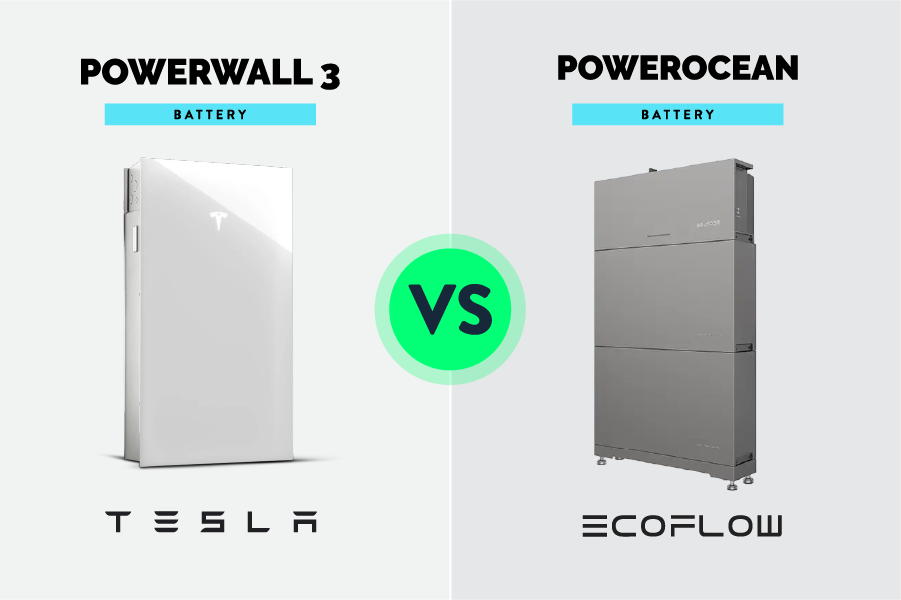
| Tesla Powerwall 3 | EcoFlow PowerOcean Battery | |
|---|---|---|
| Usable Capacity | 13.5kWh | 5.1 kWh (5 kWh module) |
| Maximum Storage Capacity | 94.5kWh - 4 Main Powerwall Units, 3 Extension Packs Per Powerwall 3 | 15kWh - 3 Batteries per Stack |
| Max Charge Rate | 5 kW with 1 Battery 8kW with the Addition of at least 1 Expansion Pack | 2.5 kW (5 kWh module), 4 kW (8 kWh module) |
| Max Discharge Rate | 8 kW | 6 kW (inverter dependent) |
| IP Rating | Powerwall - IP67 Gateway - IP55 | IP65 |
| Inverter Size | Up to 11kW | 3kW - 6kW |
| Maximum Solar Input | Up to 20kW | Up to 12kW |
| Round Trip Efficiency | 90% | 94% |
| Cell Technology | Lithium Ferro Phosphate (LFP) | Lithium Ferro Phosphate (LFP) |
| Size | Powerwall - 1105 x 609 x 193 mm Expansion Pack - 1105 x 609 x 168 mm Gateway - 584 x 380 x 127 mm | Inverter - 679.6 × 182.7× 280 mm 5 kWh Module - 680 × 183 × 452 mm |
| Weight | Powerwall Wall - 130 kg Expansion Pack - 110 kg Gateway - 11.4 kg | Inverter - 21.5 kg 5 kWh Module - 59.2 kg Base - 70 kg |
| Monitoring | Tesla Monitoring 3.6 from 1.8K Ratings (App Store) | EcoFlow Monitoring 4.6 from 657 Ratings (App Store) |
| Warranty | 10 Years (unlimited cycles, 80% capacity retention) | 15 years, or 6,000 Cycles. |
EcoFlow Vs Tesla
Tesla
- Founded: 2003
- Country of Origin: USA
- Product Maturity: October 2016
- Warranty: 10-year warranty with unlimited cycles and 80% capacity retention
EcoFlow
- Founded: 2017
- Country of Origin: China
- Product Maturity: June 2023
- Warranty: 15-year warranty or 6,00 Cycles.
Tesla VS EcoFlow: Brand & Product Maturity
The Reigning Champion – Tesla Powerwall 3
Firstly, let’s remind ourselves what the Tesla Powerwall has to offer.
The first generation of the Tesla Powerwall was released in 2015, but production was limited. The Powerwall 2 was then introduced in early 2017 and the current version went into production in late 2023. Over the 10 years that the Powerwall battery has been in production it has continuously evolved into its current market leading product. Tesla has ensured that their product has a strong brand identity by being associated with their pioneering electric vehicle brand and their design philosophy has resulted in a very sleek looking product that looks as good as it performs. The all-in-one nature of the product means that the hybrid inverter (the part that converts AC to DC and vice versa) is fully integrated with the battery storage part of the system. This results in a very clean looking installation that is simple and fast to fit compared to some other more modular products. However, the all-in-one nature of the product results in a rather hefty total installed weight of 132kg.
The Contender – EcoFlow PowerOcean
Whilst EcoFlow is a market leader in the premium portable power station market, the PowerOcean product line is their first entry into the fixed home battery market. This all-new product features a modular approach to its design which provides the user with a great deal of flexibility when specifying their requirements in order to better meet their individual needs. This design also means the homeowner can grow their system organically and continuously scale it to cater for their future requirements. Once the individual elements of the system are combined the result is a very good-looking home storage system that will undoubtably appeal to the design conscious premium end of the home energy storage system market.
The EcoFlow PowerOcean is indeed an interesting entrant into the solar battery market but let’s take a deeper look at specifications of these two quite different options, to determine whether the Tesla or Ecoflow battery is the right option for your home.
Warranty
When it comes down to warranty, Tesla’s Powerwall 3 comes with a 10-year warranty covering the battery, Tesla Gateway, and any expansion packs, guaranteeing 80% capacity retention at the end of this period. The total number of full charges and discharges, or charge cycles, under the warranty is unlimited, provided the system stays connected to the internet.
In contrast, the EcoFlow’s PowerOcean offers a longer 15-year warranty, but with a limit of 6,000 charge cycles. This guarantees 70% usable capacity after 15 years or 6,000 cycles, whichever comes first. A single full cycle each day for 6000 days is the equivalent to over 16 years of daily use.
Product Form
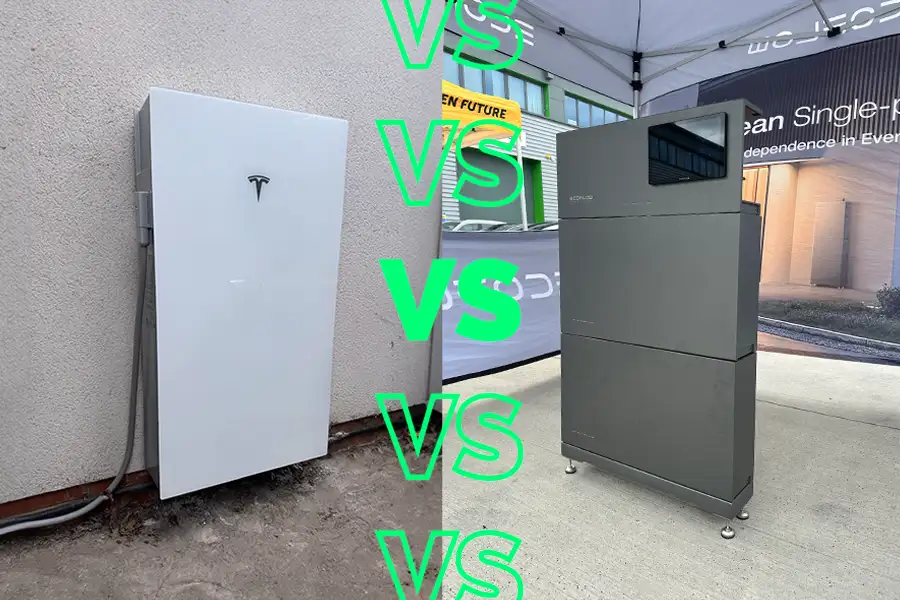
At 132kg the Tesla Powerwall 3 is a large heavy all-in-one unit that can be wall or floor mounted. It has an IP67 rating meaning that it is completely sealed from dust and can even be immersed in water up to 1 metre for 30 minutes.
Once installed the Powerwall 3 protrudes around 193mm from the wall and the main unit measures 1105mm by 609mm. Due to its size and weight, the Tesla battery requires special equipment or a team of installers for safe manoeuvring, which increases both installation time and costs.
While the Tesla Powerwall 3 delivers a sleek, minimalist design with a replaceable glass front panel for a premium finish, the EcoFlow PowerOcean embraces a modular, industrial aesthetic with its anthracite-grey frosted matte metal casing and stackable form.
The PowerOcean EcoFlow Battery features a stackable, modular design that can be secured to either a solid wall or positioned as a floor-standing unit. It has an IP65 rating meaning that it is also suitable for both indoor and outdoor installations.
Each EcoFlow battery module measures 680mm x 183mm and weighs 59.2kg. Thanks to its modular design and built-in battery handles (included free), installation is quick, simple, and requires less manpower. The final stack size will vary depending on the number and type of modules used.
Both systems can be safely installed outdoors in the UK, operating between -20°C and +40°C, though performance may reduce at the extremes. Full sun exposure in summer isn’t recommended, but both handle UK winters well thanks to internal heating elements.
Battery Capacity & Scalability
Tesla Powerwall 3
- 13.5kWh usable capacity.
- Supports 4 stacks per phase, with 3 additional expansion packs.
- Expandable up to 94.5kWh of battery capacity per phase.
- The round trip efficiency of the system is around 90% meaning that for every 100kWh stored in the system you will get 90kWh back out.
EcoFlow PowerOcean Battery
- Modular design, stackable in 5kWh Ecoflow Battery Modules.
- Supports 3 modules Per Stack, for a Maximum of 15kWh.
- Expandable up to 60kWh of battery capacity on Three-Phase and 45kWh when installed in parallel on Single-Phase.
- The round trip efficiency of the system is around 94%, meaning that for every 100kWh stored in the system you will get 94kWh back out.
When choosing between the Tesla Powerwall 3 and the Ecoflow PowerOcean Battery, battery storage capacity and expansion are key considerations.
The Tesla Powerwall 3 battery has a 13.5kWh usable storage capacity. If this isn’t enough, then additional 13.5kWh Tesla Powerwall expansion packs can be added up to reach a total of 94.5kWh on a single phase via a harness. Which, while already impressive, will soon be expandable to support up to 16 Powerwalls in the future. Whilst the additional expansion packs look almost identical to the primary unit they do not include an inverter and as such are cheaper.
In comparison, the EcoFlow PowerOcean’s modular approach offers battery modules of 5.1kWh that have a depth of discharge limit of 95%. This results in each battery module having 5kWh of usable capacity. For a single phase installation 3 battery modules can be combined to achieve a total usable capacity of 15kWh. This flexibility is a real bonus for people not needing the full capacity straight away but wanting to remain flexible and keeping options open for future expansion. Furthermore, 3 such battery and inverter stacks can be installed to achieve 45kWh of storage in total on a single-phase system with a peak capacity of 60kWh available on a three-phase system.
Whilst the Tesla Powerwall battery system offers greater storage capacity overall, one advantage of the EcoFlow Home battery is that each battery module has its own Battery Management System (BMS). This means that in the unlikely event of a battery fault in one module all other battery modules would continue to operate normally. This is a useful energy security feature of this modular design ethos. Whats more, their modular approach means that maintenance might be simpler and more cost effective, as replacing an inverter or battery module is much faster and easier than working on an integrated inverter as seen in Tesla’s Powerwall 3.
Inverter Size & Scalability
Tesla Powerwall 3
- Comes with a 11.5kW Built-in hybrid Inverter
- The integrated inverter can be adjusted in size through the software, 3.68 kW – 11.5 kW.
- Supports up to 20kW of maximum PV Power per phase.
- Supports 3 MPPT
EcoFlow PowerOcean Battery
- Modular design offering options of 3kW to 6kW on a single phase.
- Three-phase options: 6kW to 29kW per phase.
- Supports up to 12kW of maximum PV Power.
- Dual MPPT
The Tesla Powerwall 3 has a built-in hybrid inverter featuring up to 11.5kW continuous output and a continuous charge rate of 5kW to the battery. This feature will allow it to power almost any UK home. With the addition of just one Tesla expansion pack, this charge rate then increases further to 8kW.
Unique to the Powerwall 3, is its software-adjustable inverter size, it can be set on commissioning to meet any DNO requirements, this also means that you can potentially add more solar panels to your systems at a later date without the need to physically upgrade your inverter.
The Ecoflow hybrid inverter comes in several power options from 3kW to 6kW for single phase usage and 6kW to 29kW for 3 phase installations. Most homes in the UK have a single phase electricity supply so the 6kW inverter would be the likely choice allowing maximum continuous output of 6kW and a continuous charge rate of 6kW to the batteries. So whilst the Ecoflow offers lower options on single phase, it has greater diversity than the Tesla Powerwall on three-phase.
PV Input
In terms of PV input, the Tesla Powerwall can support 20kW of solar, whereas the largest EcoFlow hybrid inverter in their PowerOcean range can only support 12kW of solar. This means the Tesla system can accommodate larger solar arrays, without installing additional inverters, making it better suited for homes with higher energy demands or those looking to maximise self-sufficiency.
MPPT Range
While the EcoFlow system comes with a Dual MPPT input, unless paralleled, the Tesla Powerwall offers 3 MPPTs (Maximum Power Point Trackers), supporting up to 6 strings of panels. With more MPPTs available, choosing a Tesla system vs an EcoFlow system gives you greater design flexibility. Additional MPPTs allow you to connect more strings of panels facing multiple roof orientations ie. east, west, and south, at varying inclinations, or on partially shaded rooftops, resulting in a higher overall energy yield without the need for extra solar inverters.
Start Up Voltage
Whilst Ecoflow has a competitive MPPT Voltage range of 90V-520V, Tesla Offers both a lower start-up voltage and wider voltage range of 60 – 550 V. A lower start-up voltage means solar panels can start producing electricity sooner in the morning or later in the evening, when the sunlight is weaker. This leads to more hours of operation, which means more solar energy is captured over the day for a greater return on investment. Systems with low start-up voltage can still function partially even on overcast days, something the UK knows a lot about, maximising your energy generation throughout the course of the year.
Price: Is Tesla Powerwall 3 or EcoFlow PowerOcean Cheaper?
Package Price Comparison
| Brand | System Size | Inverter Rating (kW) | Total Battery Capacity | Gateway Included | Estimated Installation Cost | Cost per kW | Cost per kWh |
|---|---|---|---|---|---|---|---|
| EcoFlow | 7.3kW | 6kW | 15kWh | No | £12,695 | £174 | £846 |
| Tesla | 7.3kW | 11kW | 13.5kWh | Yes | £14,795 | £202 | £1096 |
*This price includes installation, IWA registration, MCS certification, 1 side of access equipment, DNO registration and 5 years workmanship warranty.
Additional Batteries
| Brand | Total Battery Capacity | Estimated Installation Cost | Cost per kWh |
|---|---|---|---|
| EcoFlow | 5kWh | £1680 | £336 |
| Tesla | 13.5kWh | £5160 | £382 |
*This price reflects the cost of upgrading the storage capacity within our package offers. When additional storage is installed alongside solar panels or an inverter, the customer can save on labour costs.
Battery Technology
Both Tesla and Ecoflow use a battery chemistry known as LFP (Lithium iron Phosphate). This chemistry is both safer in terms of fire risk and longer lasting in terms of cycle life than NMC (Nickel Manganese Cobalt), which was used in the Tesla Powerwall 2 and other older batteries. NMC is still commonly used in electric vehicles as it has a higher energy density so weighs less and takes up less space in a vehicle. For a stationary installation such as a home battery the advantages of LFP’s longer life and greater safety make more sense. As the elements used in LFP batteries are more readily available and cheaper to source than those in NMC batteries, LFP is also cheaper to produce which allows the finished product to be sold at a more competitive price.
System Compatibility
Works with Power Optimisers
Unlike the Tesla Powerwall 3, the EcoFlow PowerOcean works with a range of power optimisers, such as Tigo. This makes the EcoFlow home battery system a stronger option for installations affected by shading, as optimisers help reduce shading losses, increases design flexibility and safety, maximises energy generation and much more.
The Tesla Powerwall 3, on the other hand, does not support optimisers due to its integrated Arc-Fault Circuit Interrupter (AFCI) technology. This safety feature continuously monitors for electrical arcs within the Solar PV System and, if detected, automatically disconnects from the grid for peace of mind.
Works with Octopus Energy
Both systems are able to integrate with smart tariffs such as Octopus Flux or Agile to maximise savings in energy costs whilst also selling excess energy at the best price possible.
Energy providers such as Octopus Energy, Eon and British Gas offer special Time Of Use tariffs that offer cheap rate electricity during the times at which the grid has a lower demand. These times are generally at night time while most of the country sleeps. A homeowner with a home battery storage system that works directly with Octopus Energy, can take advantage of these times automatically in order to charge their batteries for a fraction of the cost of peak time electricity. By doing this one can save on energy costs even without solar panels. This enables homeowners to strategically plan their energy usage to capitalise on the most economical energy rates available.
Tesla or Ecoflow: Home EcoSystem
Both the Tesla Powerwall and EcoFlow Home Battery offers an ecosystem, a network of products and services, that are interconnected for a seamless user experience.
The Tesla ecosystem is a fully integrated solution for renewable energy and electric vehicles. Combining home battery storage, Tesla EVs, Tesla EV chargers, the Supercharging network, shared software platforms, and even solar tiles (not yet available in the UK). This allows homeowners to generate, store, use, and charge entirely within the Tesla ecosystem. With its strong focus on electric vehicles, it’s the ideal choice for those already invested in the Tesla Motors brand.
Alternatively, the EcoFlow ecosystem focuses primarily on home energy, integrating solar and storage, the EcoFlow PowerHeat ASHP, a smart immersion diverter, EV charger, app, smart plugs, and the EcoFlow PowerInsights—a modern 10-inch display that seamlessly connects to your system. Overall, EcoFlow provides a broader, more comprehensive ecosystem designed for homeowners prioritising home energy management.
Back up Power
The Tesla Powerwall 3 offers full home backup with UPS (Uninterruptible Power Supply), ensuring a seamless transition during outages. In comparison, EcoFlow’s current backup options are more limited. The PowerOcean battery only supports EPS (Emergency Power Supply), capable of delivering up to 6kW of continuous off-grid power, enough to cover essential loads but not an entire home.
EcoFlow is expected to unveil its own solar gateway at Solar & Storage Live in Birmingham this September 2025. Be sure to subscribe to our YouTube channel @deegesolar for the latest updates. That said, this will be a newer, less mature solution compared to Tesla’s established system.
Tesla’s Storm Watch
A feature that has made the Powerwall 3 battery a popular choice in regions where hurricanes or tornadoes are a common occurrence is its Storm Watch feature. This will react to local storm warnings by ensuring your Powerwall 3 is fully charged before any such event so that if a power cut occurs the homeowner is in the best position to weather the storm! Overall when it comes down to Tesla vs Ecoflow for backup power, there is one clear solar solution ahead.
Safety Features
Tesla Powerwall 3 Saftey Features
- Arc Fault Circuit Interrupter (AFCI)
- Rapid Shutdown (RSD)
- Fitted with a Mid-Circuit Interrupter (MCI) Solar Shutdown Device.
- Thermal Monitoring and Management
- Integrated Switch Locking Mechanism
- Ground Fault Protection
- Built-in Protective Earth Impedance Check
EcoFlow powerOcean Safety Features
- Grid Fault Protection
- Active Fire Suppression system per battery module.
- AC Overvoltage Protection .
- AC Short-Circuit Protection.
- AC Overcurrent Protection
- PV Reverse Polarity Protection
- Anti-Islanding Protection
- Insulation Resistance Detection
The Final Verdict on Tesla Powerwall 3 or the EcoFlow PowerOcean Battery
Key reasons why you should choose the Powerwall 3
- A Reputable Brand you can trust to be in the industry for a long time with great product maturity.
- A Greater Voltage range on the MPPTS and More MPPTs inputs for greater design flexibility and generation.
- Supports a greater storage capacity, and a greater DC input for more solar.
- Customisable Back-up Power Options, with a mature Gateway and Tesla’s Storm Watch.
Key reasons why you should choose the Ecoflow PowerOcean system
- Modular storage for flexible expansion and ease of installation.
- Superior ecosystem for home energy management and future proofing if you are considering an ASHP.
- Compatible with Solar panel optimisers to mitigate the impact of shading.
- More cost effective and affordable option.
- Comes with an industry-leading 15 Year Warranty.
Choosing between Tesla Powerwall 3 or the Ecoflow PowerOcean ultimately depends on your personal preferences, home energy needs and future plans.
On the one hand, the Tesla Powerwall 3 is a premium all-in-one home energy storage solution that has been evolving for 10 years, it is tried and tested and its record of achievements speaks for itself. It offers incredible scalability but in 13.5kWh stages. This may be ideal for some users but not so much for others. It is a simple system that does not require too much thought as the options are limited. It’s sleek and simple all-in-one design attracts many buyers and homeowners who have already bought into the Tesla Motors brand, may be swayed towards this option in order to keep everything in the same ecosystem.
On the other hand, the Ecoflow PowerOcean’s modular approach offers a more flexible investment with a system that might take a little more thought initially but one that offers many more options when it comes to growing with the household. As your needs develop, change and your ecosystem expands. It is also a premium choice and looks sleek and sophisticated with its distinctive modern grey finish and clean modular design.
Both the Tesla Powerwall 3 and EcoFlow PowerOcean battery are excellent choices for homeowners looking to cut grid reliance, save on rising energy costs, and/or work towards a net zero home. Not sure which is right for you Tesla or Ecoflow? Our energy advisors can help you find the perfect match. UK homeowners can call us on 01322 479369 or click ‘Enquire Now’ to explore your options.